
The Jantar Mantar Movement: A Victory of Anger, an Unfinished Politics: Part-2
(Translated into English from Original Bengali Text)
Is the Movement Truly Nationwide?
The Jantar Mantar protest has been described as a nationwide movement, whose central point was Delhi. But a movement that spreads across several major cities and becomes a genuinely nationwide mass movement is not quite the same thing.
A candidate from Rajasthan, the child of a lower middle-class family from Bihar, a college student from Kolkata, a student from the Northeast, and a first-generation learner from an Adivasi community may all write the same exam at the same centre. But when it comes to social reality, they do not sit the same exam. The questions they answer may be the same, but their social status, opportunities and access to preparation infrastructure are not. One candidate may have prepared for the exam for five years. Another may not have had that advantage. One may have devoted her entire time to studies. Another may have had to contribute to the family income while continuing her education. One may have enjoyed the privilege of private tutors, a high-speed internet connection, a room of her own, and attended a ‘good’ school, while enjoying the advantage of being fluent in English. Another may be a first-time learner in the family. That everyone has to answer the same set of questions does not make the competition equal. This is where the politics of merit becomes much more complicated and layered.
Imagine beginning tomorrow, every exam becomes completely secure. No paper is leaked, and no irregularity occurs in the examination process. Even then, a candidate from a wealthy family and a poor candidate will not start from the same place. Nor will a Dalit student and an upper-caste candidate. Between a transparent exam and equal opportunities lies a huge gap, economic and social, and political too.
In such a situation, a movement's political language should be more complex. A demand for a transparent examination process should lead to a demand for equitable education, and to a larger question about a just society. A movement is not characterised as nationwide simply because marches in support of it are held in several cities. Alongside the issues raised at Jantar Mantar, the experiences of students in district government schools, colleges in rural areas, hostels for Adivasi students, universities in neglected regions and low-income households must also become part of the political vocabulary of a genuine nationwide movement. Otherwise, the movement can be geographically countrywide but socially narrow.
Politics lies in moving from the rights of candidates writing an exam to the rights of general students, from the rights of students to the right to education to the larger question of social rights.
The Movement's Demands, and Political Direction
For precisely this reason, we cannot ignore the extensive market that has developed around exams, especially competitive exams. The higher the number of candidates, the lower the number of available seats, and the more a person’s future is tied to the outcome of one exam, the greater the incentive to pay for special coaching to gain an advantage.
In such circumstances, education ceases to be only education. It becomes a commodity. A student whose family can afford additional coaching enters the race with a clear advantage. A child whose family cannot do so starts several steps behind. It’s obvious that a student’s status depends on the transformation of privilege into merit. And yet the state stamps the label of ‘merit’ on this unequal competition, as though the socioeconomic inequalities accumulated before those few hours inside an examination hall simply do not exist. There is something grotesquely absurd about it. A competition cannot be fair in a society where preparation for that competition is unequal.
The responsibility of the state cannot end with just guarding question papers. The quality of government schools, free or affordable access to exam preparation, increasing the number of government medical colleges and seats, and higher budget allocation for higher education should all form part of the discussion. When it comes to NEET, the scale of the crisis is evident in the numbers. Millions of students sit an exam that offers a minuscule number of seats. The value of a single mark therefore gains immense importance. So is the social cost of an ordinary irregularity. The pressure created by the examination system cannot be reduced simply by making exams more secure. There is also a need to increase educational opportunities. Hence, the demand for more government medical colleges and more seats is a question not only of NEET candidates' interests but also of the country’s public healthcare infrastructure.
But behind the extraordinary importance attached to exams lies another, even larger, crisis: unemployment. The life of innumerable youths today is organised around exams. An exam after school, another to enter a college, more exams after graduation to get a job. If one exam does not work out, preparing to write another and another. It’s not that Indian youths have a special fascination for exams. When the road to a stable, secure and dignified life outside the examination system becomes increasingly narrow, crowds of people will inevitably vie for the few doors that remain open and lead there. The larger the crowd, the fiercer the competition. As a competition becomes more consequential, an exam becomes more valuable, and when an exam becomes more valuable, question papers acquire a market price of their own. Assuming paper leaks to be the result of scams or the handiwork of criminal gangs would be mistaking a rope for a snake. A larger economic cycle is at work behind them. ‘Conduct exams honestly and fairly’ thus becomes an important demand. Equally important is the question: Why should the future of millions of youths remain trapped within a handful of exams and an absurdly small number of seats? It is only a short political leap from this question to the issue of unemployment, and from there to the economy. Perhaps this is where the possibility of a movement centred on examination candidates becoming a broader youth movement emerges.
How Should the Left Read the Movement?
But why and how did the NEET paper leak so quickly turn into visible political anger? An obvious answer would be the scale of the scandal that jeopardised the future of millions of candidates. NEET is closely tied to the aspirations of middle- and lower-middle-class families, who, incidentally, possess greater political and social visibility. Yet many other crises are unfolding in the education system. Thousands of government schools don’t have enough teachers. School infrastructure across large parts of the country remains appalling. Higher education has barely reached Adivasi regions in any meaningful sense. University fees are rising rapidly. Hostels are inadequate in numbers. Scholarships are not being paid to students. Access to higher education remains unequal across caste, class, gender, language, and region. There is growing public anger over these issues, reflected in protests demanding improvements.
But not all anger is equally visible, and not every grievance reaches Jantar Mantar. Social groups that have greater opportunities to make their grievances heard receive more attention from traditional media and can more easily generate support on social media. Their crisis can therefore acquire the shape of a nationwide crisis much more quickly. On the other hand, some of the most marginalised communities continue to struggle with an educational crisis without attracting any media or political attention. The situation, therefore, is conducive to a NEET-like movement spreading beyond its immediate social constituency. If the anger of middle- and lower-middle-class candidates remains confined to the demand for transparent exams, the NEET movement might get its important demand accepted but leave the bigger education crisis untouched. But if the protesting youths widen their ambit from the rights of students and candidates to the right to education, and from there to social rights, they can change the political character of the movement. This is an important test especially for Left student and youth politics.
The political language of the new generation has changed. The new generation uses memes. It uses satire. It organises through social media. It is suspicious of established political parties and conscious about maintaining its political independence. It’s easy to dismiss the new generation’s language as shallow, as it is to try, in haste, to pull its movement into the old political vocabulary and organisational structure familiar to us. Both approaches are problematic.
The task of the Left is not to ‘capture’ the new generation’s movement. Nor is it to stay clear of it, mock its supposed political immaturity, and not build a meaningful political relationship with it. What is necessary is to find the path from the NEET crisis to the crises of public education, unemployment and economic policy. It is equally necessary to bring into focus the relationships among class, caste, and social inequality in the system, and to ensure the focus stays on those issues until the state resolves them.
Why do certain groups of youths fall behind when it comes to preparing for an academic and competitive exam? Why don’t they receive quality education in government schools in the first place? Why are thousands of youths fighting for the few seats in government medical colleges? Why is graduating from college no longer an assurance of getting a job? These are not only questions but decisive factors in millions of people’s lives. A political dialogue is possible only when we make an effort to see and bring into public focus the relationships among power, state and class that decide the fate of millions of people.
The Movement and the State: Learning from the Struggle
Another important dimension of a movement is whether or not it directly confronts the state. In a democratic state, a peaceful protest is not a crime. Sit-ins, slogans, hunger strikes, and demands that the government resolve life-deciding issues are all part of democratic politics. The use of police force and arrests, and levelling criminal charges at protesters are not merely questions of law and order; they also put a question mark on the democratic character of the state itself.
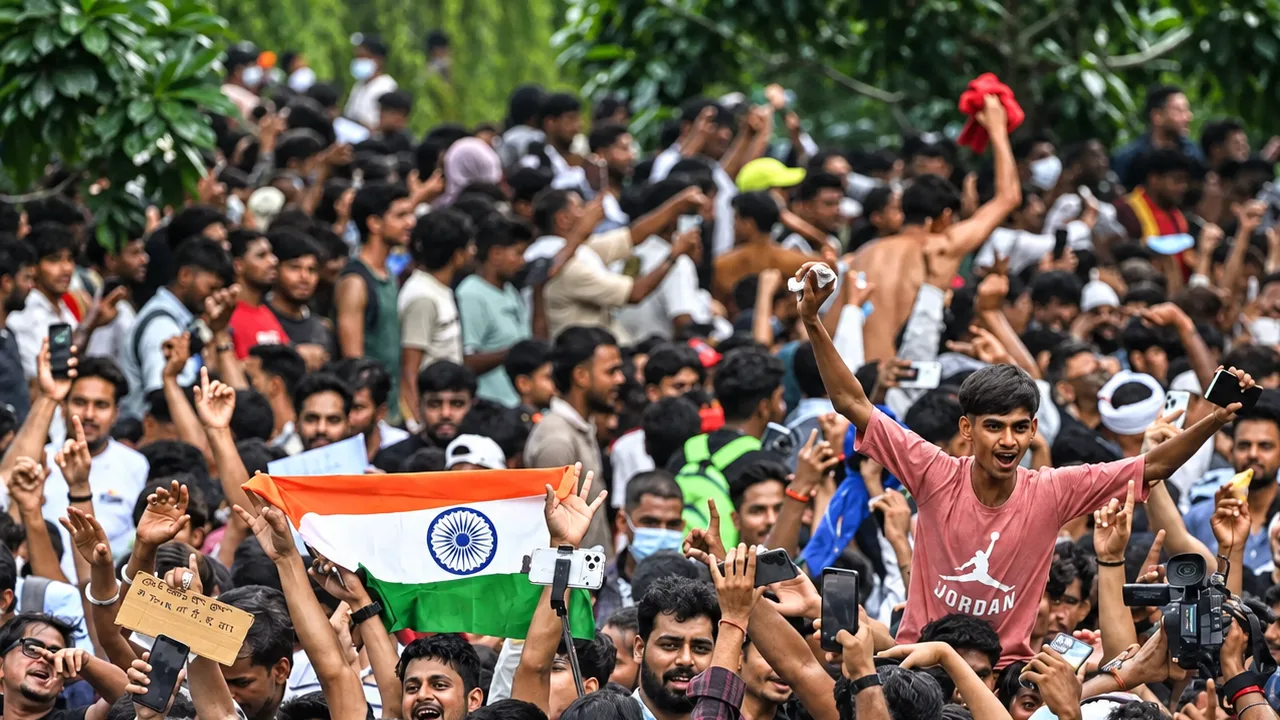
The Jantar Mantar movement has put the BJP government in a spot, and made the established opposition uncomfortable. The fact that a section of protesters has expressed distrust towards established political parties does not mean the youths are anti-political. In fact, their questions are intensely political and remarkably direct. Where are the jobs? Why are exams not secured? Why do government colleges have so few seats? Why is it so difficult to compete with privileged students without access to special preparation, which can cost a bomb? Who is responsible for the time and money candidates lose when an exam is cancelled? It will be difficult to build a durable political relationship with these youths by offering anti-BJP slogans rather than answers to those questions. Also, if an opposition party attempts to turn the movement into an extension of its own student or youth wing agitation, there is a real risk of the movement losing the very independence that gave it much of its force. Indeed, the relationship between the movement and established opposition politics is complicated. One needs the other, but there are reasons for mutual suspicion.
Opposition parties will naturally welcome a movement that rattles and weakens the government and helps channel the accumulated public anger towards electoral politics. But what happens if the movement refuses to stop there? What if its anger is not confined to opposition to the BJP? What if it begins to question the condition of education, employment, the state, the economy, and eventually the conventional opposition itself? At that point, India’s political arithmetic could begin to change.
The future of the Jantar Mantar movement, therefore, does not depend only on how the government responds; it also depends on how the opposition understands the movement, the CJP’s roadmap, and, perhaps most importantly, how the youths who took to the streets for the first time perceive what they just experienced.
Maybe the most significant political possibility emerging out of this movement lies with those who, for the first time, felt the heat of a movement up close, those who took to the streets together, probably shouted slogans awkwardly, stayed awake through the night, faced police batons, and through it all experienced something new — collective action — since politics, for them, was a distant island till then.
These experiences are invaluable. Many of the youths at Jantar Mantar, for the first time, witnessed in person how police personnel speak and behave, how the administration procrastinates, how biased media outlets present an event in a totally different light, observed how an opposition leader stood beside them, analysed why the leader was there, and realised how things would change if the political interest of the leader’s party took precedence over the movement. They also realised that the leader standing beside them is angry for the same reason, has the same grievance and feels the same sense of injustice.
Together, these experiences could be part of their political education, education acquired through experience. Many of the youths who took to the streets to protest the NEET paper leak may be busy preparing for another examination next year and may never join another movement. Or, perhaps, after their novel experience, they might slowly realise that their protest was never about NEET alone. The exams are connected to public education, which in turn is connected to the economic health of their family. Somewhere in all this lie employment, state policy, class, caste, religion and region. This is perhaps the greatest political possibility their experience can create. Generally, a movement is judged by the number of people it brings together. But it should also be judged by the number of people it teaches, for the first time, to politically analyse their own lives and problems, and the system around them.
That’s why the Jantar Mantar movement should not be measured in terms of Pradhan’s resignation alone. A youth who sees for the first time how organised pressure can force the state to respond and meet the youths’ demands, and that even a powerful government can sometimes be made to retreat carries that experience lifelong. In politics, experience is invaluable.
What Comes After the Movement?
Many of the countries the Arab Spring swept across didn’t get a better, more democratic government. In Egypt, following the fall of the Hosni Mubarak regime after almost 30 years, Mohamed Morsi, backed by the Muslim Brotherhood, came to power through an election. But a more complicated political development followed. Morsi was ousted in a military coup, with Egypt moving towards a more authoritarian rule under Abdel Fattah el-Sisi. In Tunisia, Lebanon and Syria, too, the post-Arab Spring order is not necessarily democratic. Occupy Wall Street, despite its global impact, new political language and symbolism, and its immense political energy, didn’t lead to a durable restructuring of state power. From Europe to the Arab-speaking region and Latin America, many movements since 2011 have ended, creating a wide gulf between the political possibilities that emerged in the beginning and the political arrangements that they gave rise to.
This is where Bevins’s question becomes particularly important. A huge crowd of protesters can generate political power. It can bring down governments and render an old political structure dysfunctional almost overnight. But the future of that power cannot be determined. Simultaneously, the question of who occupies the political vacuum — or the political space created by a movement — can become more important than the original demand of the movement.
And yet, keeping the history of all the movements in mind, the Jantar Mantar movement still needs to be viewed differently. The movement directly pointed at a government that is reportedly moving in a fascist direction, questioned the power of that government, refused to accept its authority as inevitable, and forced it to negotiate and even retreat. These signs and differences do matter.
That does not mean there is no possibility of the opposite happening. The movement may appear promising today — and give rise to numerous new political possibilities — but that is no reason to assume its eventual political outcome will be equally promising. In today’s political context, this movement, this surge of people, calls for serious re-evaluation. History tells us to fear what could follow in the wake of such movements. Yet this movement also gives us the courage to question that fear — and perhaps to dream again.