
The Jantar Mantar Movement: A Victory of Anger, an Unfinished Politics: Part-1
(Translated into English from Original Bengali Text)
Forty-nine days that shook Delhi! Some people have described the Jantar Mantar movement thus.
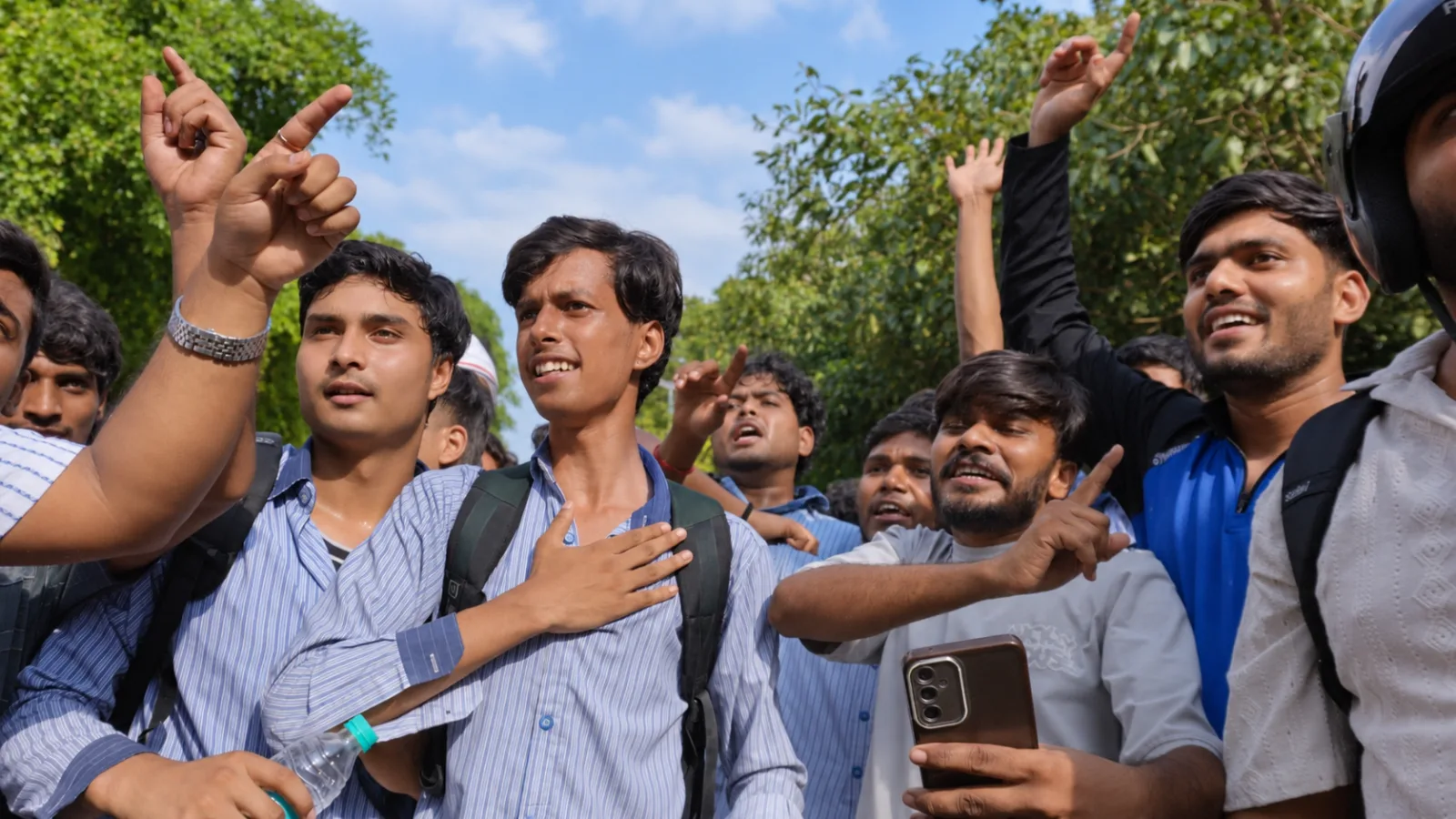
No denying the description has a certain appeal. But to call it a movement that shook Delhi would perhaps be an understatement of what really happened. There’s little doubt it was unprecedented in India’s recent political history. Youths from the so-called Gen Z formed a major part of the movement, whose language and mode of organisation — and the manner in which it spread across the country — often fell outside known political structures. There were other factors, too, which made it unusual. We’ll discuss those later.
Let us begin with the immediate ledger of gains. The resignation of Union Education Minister Dharmendra Pradhan met one of the movement’s principal demands, which revolved mainly around corruption and irregularities in the education and examination system. Subsequently, educator and social climate activist Sonam Wangchuk and others ended their hunger strike and called off the Jantar Mantar protest.
On the face of it, there is little doubt the movement achieved a significant victory. Pradhan’s resignation was, without question, a major political achievement of the movement. A powerful government was forced to retreat under pressure from the street protests, which itself is an indicator of the movement’s impact, given the political climate of the past several years. However, if Pradhan’s resignation is seen as the pinnacle of the movement’s success, we risk missing something larger: the movement likely opened the door to a political possibility greater than the acceptance of its demand/s, especially because the anger of the students and youths didn’t subside with the withdrawal of the protest at Jantar Mantar. Across the country, anger over the examination process, recruitment failures, poor educational quality, and rising unemployment has continued to spill onto the streets. Protests over recruitment, or the lack thereof, have persisted in Bihar. In Jharkhand, too, student and youth anger over an erroneous recruitment process and rising unemployment pressured the state government to take corrective measures. In Bihar, Uttar Pradesh, Rajasthan and Haryana, even school students — the so-called Gen Alpha — have taken to the streets to demand improvement in schools and the education system. The places are different, so are the demands and organisations. Hence, there is no reason to describe all of them as extensions of the Jantar Mantar movement. But that is no reason to ignore the larger pattern: in the same political moment, the anger of different generations has been repeatedly reflected in protests against the leak-prone examination system, a faulty and biased recruitment process, declining educational quality, and, more importantly, the future of youth.
So the Jantar Mantar movement cannot be evaluated solely on the demands the government met. We also need to ask what the movement actually did. Did it merely force a Union minister to resign? Or did it reopen a window for opposition in India’s suffocating political space? As the BJP’s apparent victory march continues across much of the country, state power, the RSS, capital, and technology are consolidating their dense structure of domination. Yet a new movement has capitalised on a crack in that structure and widened it, reminding us that no power is invincible, no fortress impenetrable. Sometimes, it’s simply to challenge it at first.
The Politics of Crowds
Crowds make me uneasy. More precisely, I have little faith in politics built on the strength of crowds, which has no space for questions.
I’ve seen the crowds gathered behind Anna Hazare. I’ve seen the crowds that took to the streets after the Nirbhaya case. I’ve also seen the political transformations that followed. Over the past decade and a half, many more such crowds have hit the streets across the world. From the Arab Spring to Occupy Wall Street, from Hong Kong and Chile to Sri Lanka and, more recently, Bangladesh, millions of people have occupied streets and public squares, suggesting history was about to take a turn for the better. In most cases, it did not; at least not in the direction expected.
In If We Burn, Vincent Bevins revisits the mass protests and movements of the previous decade and raises an uncomfortable question. These movements brought huge numbers of people onto the streets in no time. They paralysed governments and shook the old political arrangements almost overnight. But what followed? Did they convert the immense energy generated on the streets into a durable political outcome? Did the leaderlessness and loose organisation, which constituted an initial source of strength, become a weakness once the question of political power emerged?
The subtitle of Bevins’s book provides much of the answer: The Mass Protest Decade and the Missing Revolution. As expected, revolution did not become a reality. In some places, the old order returned in a different form. Elsewhere, the political vacuum created by the protests was occupied by forces which the protesters had certainly not intended to bring to power. In other cases, the political dispensation as a whole moved further to the right, sometimes dramatically so.
That’s precisely why it is difficult, at least for now, to place the Jantar Mantar movement alongside the earlier experiences. It matters politically who the crowd questions, under what conditions it questions, and what follows once those questions are settled.
Politics in India has reached a point where the BJP is no longer perceived merely as a party that wins elections. Successive election victories that are often difficult to explain, the ease with which the electoral process itself has been fiddled with, enormous financial power, highly centralised leadership, the transformation of a large section of the media, the fracturing of opposition parties, and the hollowing out of state institutions have together created a near-invincible image of the BJP, and simultaneously narrowed the space for opposition. In contrast, the protesters at Jantar Mantar directly questioned state power and forced it to retreat, achieving the feat without the help of any conventional political party.
Despite that, it would be absurd to assume, as some have claimed citing the example of the ‘Gen Z movement’ in Bangladesh, that the movement would eventually strengthen far-right forces. Such unitary rules do not bind politics. Today’s direction does not determine tomorrow’s destination. Yet today’s direction cannot be ignored.
The Trigger: The NEET Scandal
The immediate trigger for the protest at Jantar Mantar was, of course, the NEET paper leak. NEET is not like any other competitive exam. It’s a gateway to medical education, and the future of millions of youths is tied to it. When the integrity of such an exam comes into question, the issue is no longer solely about administrative efficiency; it becomes a matter of trust in the state, social justice, and citizens’ confidence in their own future.
A NEET candidate does not just write an exam. Before doing so, she prepares for years, and her family spends its savings on coaching fees, books, mock tests, travel, and sometimes shifting to another city so their daughter can attend ‘premium’ coaching classes. Many middle-class and lower-middle-class families cut back on other needs to pay for their children’s education. So when a NEET paper is leaked, it is not only an assault on the fairness of an exam; it is also neutralising a family’s financial investment, devaluing years of a student’s hard work, shaking students’ belief that if they follow the rules, the system will do so too. It forces candidates to ask whether their years-long hard work has any real value. This is where the moral basis of merit begins to wobble. Merit can no longer be understood only as the outcome of individual labour. Larger questions subsume students. How fair are state institutions? How dependable is the state itself? Are the rules of competition really the same for everyone?
It is impossible to grasp the depth of the crisis if paper leaks are treated as isolated crimes. In India, the bridge between education and employment has been increasingly reduced to a series of exams: school, coaching; coaching, exam; exam, result; and then another exam. NEET, JEE, SSC, UPSC, banking, railway and State PSC exams — the pattern is familiar.
A student spends a large percentage of their life preparing for exams. Behind this lies a more fundamental economic problem. When an economy fails to create enough secure, stable and dignified jobs, huge numbers of youths are forced to compete for a limited number of vacancies. Exams then cease to be just a method of evaluation; they become a process of social selection. And question paper leaks grotesquely distort that process.
The political possibility of the Jantar Mantar movement would thus be incomplete if the protesters' demand stopped at holding fair and honest exams. The larger question is: Why should the future of a youth depend on a handful of exams, an absurd ranking system and a tiny number of seats?
At the centre of the NEET scandal is the National Testing Agency (NTA). Repeated allegations, technological failures, controversies over question papers, re-examinations and administrative lapses have seriously damaged its credibility. When such failures recur, responsibility cannot rest with a few employees, exam centres or criminal networks. The NTA’s structure, capacity, and decision-making process must all come under scrutiny. For precisely this reason, the demand for Pradhan’s resignation was a political necessity. As the political head of the education ministry, he was mainly responsible for the mess. True, political accountability does not mean a minister has to guard the examination papers personally. But when a system under a minister fails, and fails repeatedly over the years, the political leadership should be held responsible. In a democracy, that is hardly a radical proposition. Yet if the Jantar Mantar movement becomes synonymous with Pradhan’s resignation, the larger political possibility it created may disappear.
Yet despite the state meeting the movement’s principal demands (the Supreme Court on Sept 1 ordered the quashing of all Jantar Mantar protest-related FIRs across the country and asked the government to finalise the compensation amount for the families of the students who committed suicide following the NEET paper leak), much of the system that prompted the youths to launch the movement remains intact. The success of Jantar Mantar perhaps lies somewhere between these two facts or, more precisely, is equidistant from both.
The Jantar Mantar movement dealt a powerful blow to the idea of the ruler’s domination as seamless and perpetual. Whether that political shock will contribute to the return of increasingly debilitating parliamentary democracy is not yet clear, at least for now. It would be equally foolish to assess the movement’s political impact by election results hastily.
What Kind of Movement?
Gen Z is an interesting generation, almost uncomfortably so at times. There’s been a marked change in the language and organisation of its movement. Social media, memes, satire, livestreaming and rapid digital communication helped spread the protest. Also, despite not always being comfortable with the vocabulary of conventional politics, Gen Z can become political, that too without repeating old slogans, and question the state without carrying a party flag.
A lack of interest in conventional party politics is not the same thing as a lack of politics. A youth may not belong to any political party, but that does not mean they don’t need a job. Today’s youths may not be interested in long ideological arguments, but they may still want a transparent examination system. They may reject the language of existing political establishments and still demand quality education, stable jobs and social security.
However, the term “Gen Z movement” risks obscuring the movement's socioeconomic character. The youths who gathered at Jantar Mantar and other parts of the country did not do so because of some mysterious generational trait. They did so because they face a crisis. They not only feel their future is uncertain, but also know education is expensive, jobs are scarce, examination processes cannot be trusted, and social inequality is widening. As such, the digital language is the medium they have chosen to express their anger; it is not the source of their anger.
The Cockroach Janata Party (CJP) has added another interesting, slightly mysterious, dimension to the movement. The name itself carries an element of satire, a satire associated with established political culture. The fact that the CJP has turned the term “cockroach” from an insult to a political identity, uses memes and humour as an instrument of political communication, and keeps a conscious distance from established parties and their structures distinguishes it from conventional student or youth political outfits. In that sense, the CJP has recognised and exploited what you would call a political vacuum. But bringing people together at almost unprecedented speed onto the streets and organising them into a durable political force are two entirely different things. This is where Bevins’s question becomes especially relevant.
A meme can bring people together to protest, but it cannot help build internal democracy within an organisation. Satire can unsettle a government, but it cannot be a substitute for a long-term political programme. There is also a huge difference between going viral and building an organisation from the ground up. Without meaningful participation of members, democratic decision-making, accountable leadership, financial transparency and a clear political programme, it cannot be said with certainty where this new political language will eventually lead. That’s perhaps the most important question facing the CJP now. The grouping has demonstrated that it can look the government in the eye and build a movement capable of pressuring it. The test that remains is different: How will it carry forward the political language it created, what direction will it take, and how far will it go?
The Shape of the Movement
If we demand accountability from the state, we should also be willing to shine some light inside our own house. The allegations that have emerged within CJP — around leadership, favouritism and the exclusion of grassroots members from decision-making — cannot simply be dismissed as personal disputes. What role do ordinary members actually have? How is the leadership chosen? Who has the right to question a leader or spokesperson? What are the sources of its funds? And who decides when a protest programme should be withdrawn? None of these questions is new. Almost every new organisation born out of distrust of established political parties has, at some point, had to confront them. Rebelling against an established party doesn’t automatically make a new organisation democratic. If anything, in case it has a weak organisational structure, it could expedite the emergence of personality-driven politics.
This is also where political independence becomes important. Maintaining a distance from conventional political parties is certainly a conscious choice for a movement; at times such a decision may be necessary. But political independence is not the same as a political vacuum. A movement may refuse to be led or guided by any party. But it still has to decide what kind of society it wants to build, what kind of economy it stands for, what it demands from the state, and by what means it intends to pursue those demands.
The questions around NEET make this clear. One can protest paper leaks. But move one step further, and questions of the public education system, unequal access to preparation for competitive exams, privatisation, unemployment, and class and social inequality acquire profound importance. In such a situation, these no longer remain just questions about an exam. Keeping a distance from politics does not allow a movement to escape politics. Many movements of the previous decade distrusted established political institutions, often for legitimate reasons. But rejecting an old institution and creating an alternative political structure are not the same task. The first can happen relatively quickly. The second is a slow, exhausting, less exciting process. At the peak of a movement, bringing thousands of people together can sometimes be the easier part. Assembling those same thousands of people for a meeting and reaching a collective decision are far more difficult. And without the second task, the power generated by the first rarely remains under the movement’s control for long.
That’s why the questions about democracy within the CJP are not merely a minor internal issue that exists independent of the movement. A movement that demands accountability from the state must create mechanisms for accountability within itself. Devoid of that, the movement may develop cracks in its own moral authority. Democracy, after all, is not merely something we demand. It is also something we have to practise.
(To be Continued)