
From Street to Screen and Back: The New Vernaculars of Political Dissent
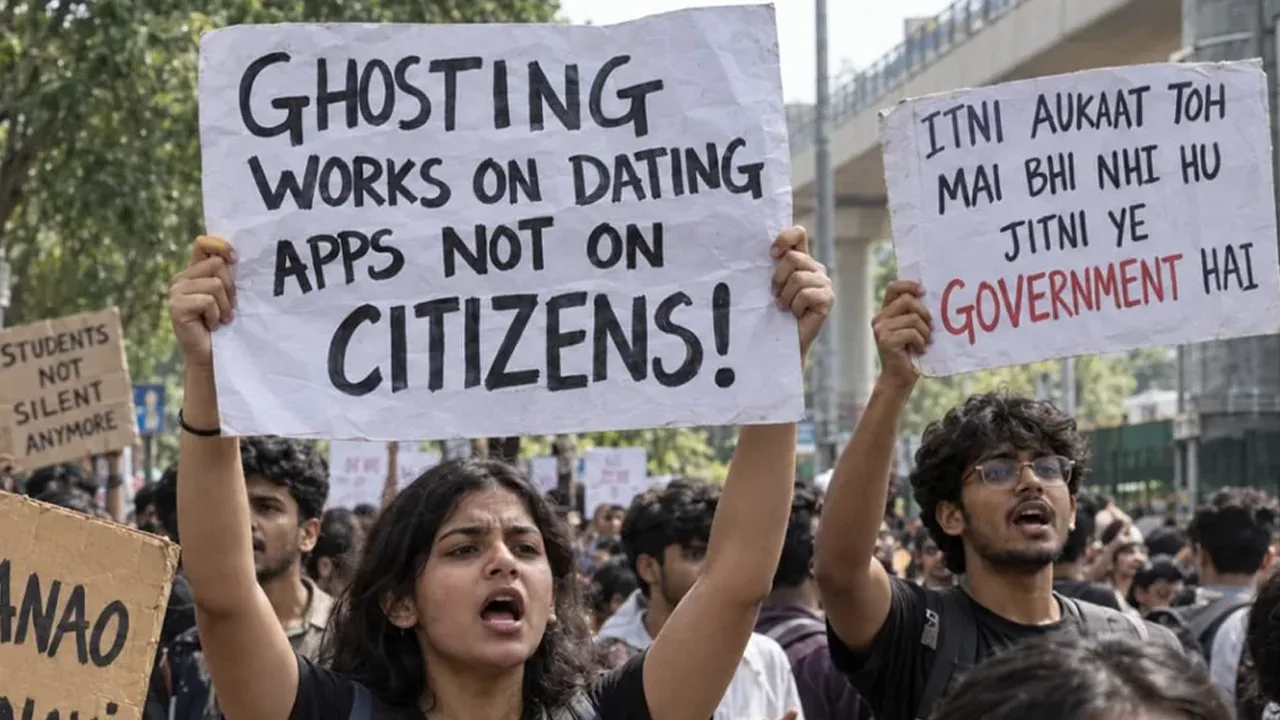
Political dissent in India increasingly travels through jokes, reels, parodies, memes, and short video clips, making it more accessible but also more fragile. Visibility is not the same as organisation, but the new popular languages of dissent matter because they change what can be said, shared and laughed at.
Dissent changes its language.
Political dissent has never belonged to Parliament, party offices or newspaper editorials alone. It lives in slogans, songs, street theatre, cartoons, campus jokes, tea-stall arguments and the stubborn refusal to accept an official explanation as the last word. What has changed in the last decade is not the existence of popular dissent but its speed, form and route of circulation.
A political joke that once travelled through word of mouth can now move across the country in minutes. A parody song can become a political event. A 60-second reel may make a contradiction visible to people who would never read a long article on constitutionalism or media capture. The screen has not replaced the street. It has altered the traffic between speech, performance and collective action.
This matters because democracy is not sustained by formal institutions alone. It also depends on a public culture in which authority can be mocked, disputed and made answerable. Dissent, in popular parlance, is often less grand than the word suggests. It can begin with a laugh: that story does not add up; that leader looks ridiculous when the script is taken away; that official phrase means something quite different in ordinary life.
But the new digital public sphere is not simply a larger, freer version of the old one. The platforms that make dissent visible are privately owned, algorithmically organised and vulnerable to political, commercial and legal pressure or crackdown. To understand contemporary popular dissent, therefore, we have to look at both sides at once: the new expressive freedom and the new forms of dependence.
The joke and the state
Kunal Kamra's 2025 confrontation with Maharashtra's political establishment offers a useful example. A parody song in a stand-up routine, widely understood as a jab at Deputy Chief Minister Eknath Shinde, triggered police complaints, political outrage, and vandalism at the Mumbai venue where the performance was recorded. Kamra refused to apologise. The episode triggered a countrywide debate about satire, intimidation, and the limits political power seeks to impose on ridicule.
The point is not that a comedian is automatically a dissident hero, or that every offensive joke becomes protected political wisdom. Satire can be lazy, cruel or merely partisan. What makes the Kamra episode important is the asymmetry it exposed. A joke is speech. The response to it can involve police power, party cadres, municipal action, litigation and threats. When power reacts to ridicule with an apparatus far larger than the joke itself, the comedy begins to expose the structure it mocks.
Satire works differently from a manifesto. It rarely offers a programme. Its political force lies in interruption. It can break the solemnity through which authority presents itself as natural, inevitable or above laughter. The audience does not have to agree on an alternative to recognise that the emperor's pose has slipped.
Reuters and other Indian media outlets reported on the 2025 Kamra controversy; it continued into 2026 as Kamra declined to apologise before a Maharashtra legislative committee.
When the meme walks into the street
In 2026, the Cockroach Janata Party pushed this transformation much further. What began as satire around a remark by the Chief Justice of India rapidly acquired a name, a visual identity, an online following, and a language of political belonging. 'Cockroach' — an insult — was appropriated and turned into a badge. That is an old political trick in a very new medium: take the language used to demean and diminish you, repeat it until it becomes yours, then organise around the inversion.
The more interesting part came when the joke refused to remain online. The CJP phenomenon moved into petitions, gatherings and protest. Digital performance became a way of producing political identity before a conventional organisation existed. The meme did not merely comment on politics; for a while, it became a form through which people entered politics.
This is precisely why the movement attracted both excitement and scepticism. One reading saw a new generation inventing its own oppositional language, free from the tired symbolism of established parties. Another saw the danger of politics becoming a performance designed for the algorithm: visually clever, rapidly consumed and easily abandoned when the trend changes. Both readings contain something true.
The old opposition between 'real' street politics and 'fake' online politics no longer helps much. Streets are filmed, livestreamed and converted into clips; clips bring people to the streets; memes become placards; slogans are designed with circulation in mind. The question is not whether politics is online or offline. It is whether the connections made through visibility can survive when visibility fades.
For background on the CJP’s emergence and its movement from satire towards protest, see Al Jazeera’s May 2026 report and the subsequent debate whether the phenomenon represented a new politics or an algorithm-driven performance.
Not every dissenter looks like an activist.
The older political vocabulary often struggles to classify cultural performers. A comedian is not a party worker. A satirist may criticise a government today and a movement tomorrow. A political commentator may have no organisation behind her at all. That does not make her work politically irrelevant.
Azeem Banatwalla, writing recently about satire and democracy, made a simple point: a joke can articulate a truth people are struggling to say directly, and healthy democracies need criticism that can make power look ridiculous. His own career shows the vulnerability of the form. Indian comedians have faced campaigns, cancellations, police complaints and threats not only because their jokes persuade voters, but because laughter creates a kind of equality between audience and authority. Once the ruler can be laughed at, it is no longer in total control of the scene.
Shekhar Suman's return to political satire with his 2026 YouTube show, Shekhar Tonite, makes a different point. Political humour has migrated from television to platforms, but it has not lost the older late-night function of using allegory, mimicry and topical jokes to puncture official rhetoric. Suman has publicly said that satire requires fearlessness and that the government cannot be kept outside the range of jokes. The medium is new, the democratic function old and recognisable.
These figures, however, should not be forced into a single ideological category. Their significance lies elsewhere. They show how political criticism now circulates through entertainment genres that audiences encounter in ordinary media use. Dissent is no longer always announced as dissent. It arrives as a reel forwarded by a cousin, a joke heard during a commute, a clip watched after dinner.
On satire as democratic criticism, see Azeem Banatwalla’s August 2026 article in The Indian Express; on the revival of late-night political satire, see coverage of Shekhar Tonite.
The platform is not a public square.
It is tempting to describe Instagram, YouTube and X as a new public square. The phrase is useful only up to a point. A square is a place people can enter. A platform is a business. Its architecture is designed around attention, data, advertising and retention. The political speech that travels through it, therefore, competes under rules written for engagement rather than democratic deliberation.
Anger, humiliation, fear and mockery often travel faster than careful explanation. The same system that helps dissent bypass traditional gatekeepers can reward abuse, disinformation and majoritarian propaganda. The algorithm has no political conscience. It amplifies what holds attention.
Nor do creators own the space in which their audiences gather. Accounts can be restricted, posts removed, reach reduced, monetisation altered, and content challenged through court action or government requests. This does not mean every takedown is censorship; defamation, incitement and unlawful content remain real legal questions. It does mean that the digital dissenter operates on rented land.
The contradiction is sharp. The platform allows someone without a newspaper, television studio or party machinery to reach a mass audience. At the same time, the speaker remains dependent on opaque systems controlled by corporations and increasingly contested by states. What looks like direct communication is mediated all the way down.
Virality is not organisation.
This brings us to the limit of digital dissent. A million views are not a million relationships. A trending hashtag is not a committee. Ten thousand people who laugh at the same joke have not necessarily developed the trust required to act together when someone is arrested, loses a job, faces eviction or needs solidarity after the cameras leave.
That does not make virality worthless. Visibility can protect people, spread information, expose state violence, create common language and help isolated individuals recognise that their anger is shared. But political organisation asks for something slower: meetings, memory, disagreement, responsibility, care, the capacity to remain when the event is over.
The CJP is interesting precisely because it sits on this fault line. If its political life remains dependent on the meme, it may disappear with the meme. If the people drawn together by it build durable local relationships and forms of collective decision-making, the joke will have done something more remarkable: it will have opened a door through which politics continues after the performance has ended.
The same test applies more broadly to digital satire. It can destabilise official common sense. But it cannot by itself build an alternative common sense. It can prompt people to ask a question. But it cannot guarantee what they will do with it.
A vernacular politics of dissent
The most useful way to understand these forms may be to see them as a new vernacular of political dissent. 'Vernacular' here does not simply mean language in the linguistic sense. It means a politics spoken in forms already embedded in everyday culture: parody songs, memes, jokes, reels, mimicry, short commentary and deliberately absurd political identities.
Formal political language often arrives burdened with authority. It asks people to listen. Vernacular dissent frequently works the other way around: it begins from recognition. The audience already knows the film song, the meme template, the slang, the familiar hypocrisy being mocked. Politics enters through that shared recognition.
This makes such dissent especially important at a time when much of mainstream political communication is scripted, branded and professionally managed. The polished speech, the choreographed interview, and the campaign slogan seek to control meaning. Satire thrives on leakage. It notices what escapes the script.
There is, however, no automatic democratic virtue in popular language. Memes can dehumanise as easily as they can liberate. Humour can punch down. Viral culture can make prejudice pleasurable. The far right understands vernacular politics extremely well. Any defence of digital dissent that ignores this would be naive.
The democratic question is therefore not whether popular culture is political. It already is. The question is what kinds of political relationships it helps develop. Does it widen the range of people who can speak? Does it make power more answerable? Does it create solidarity across difference? Or does it merely intensify the pleasure of belonging to one's own camp?
From screen to street — and after the street
Political dissent in India has travelled from petitions and newspapers to meetings and mass movements, from street theatre and protest songs to television satire, and now into reels, streams, memes and platform-native comedy. None of the older forms has disappeared. They overlap.
The new forms should neither be romanticised nor dismissed. They matter because they shape what becomes sayable, visible and laughable. Yet they can lower the threshold for entering political conversation, while also making politics shallow, episodic and hostage to attention.
A democracy needs the right to be inconvenient. It needs people who can say that the government is wrong, but it also needs spaces in which that statement can be argued against, organised around and carried beyond the moment of expression. Popular dissent is strongest when speech becomes relationship, and relationship becomes the capacity to act.
The screen can begin that process. The street can intensify it. The harder question begins afterwards: what remains when the clip stops circulating, and the crowd goes home?