
Hawkers’ Rights, Eviction and the Role of the State: Sawaal in conversation with Shaktiman Ghosh
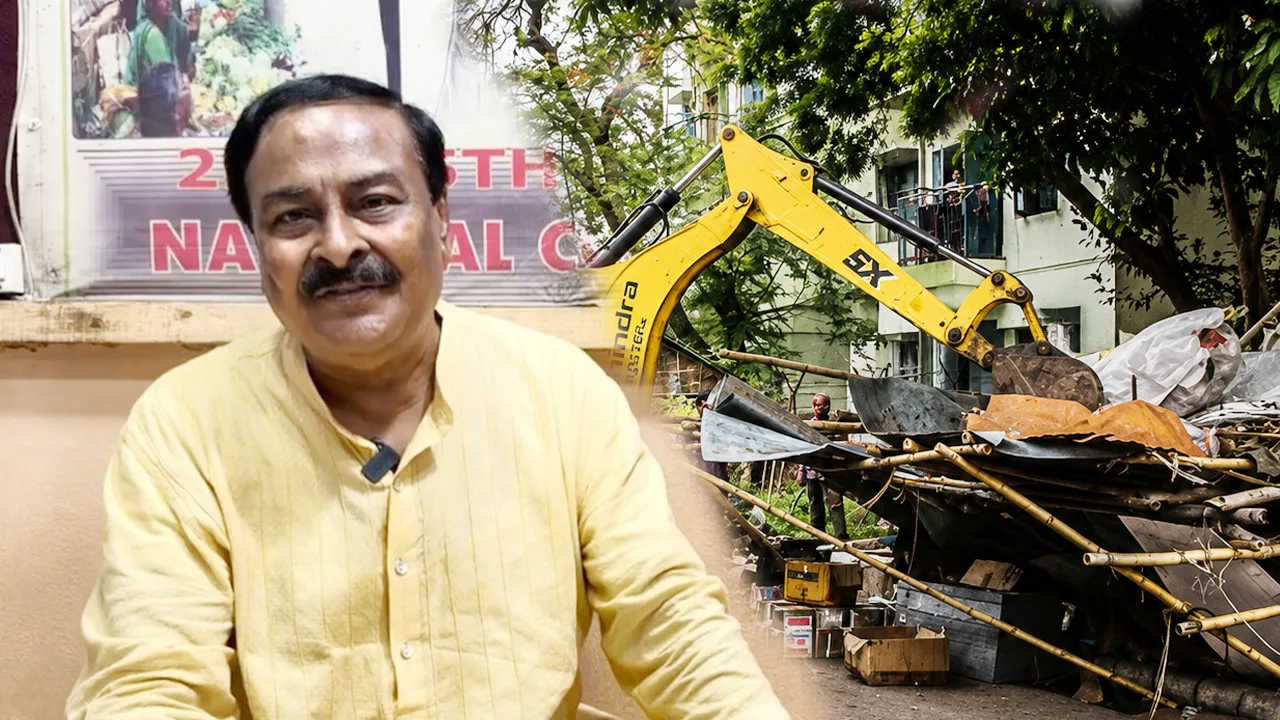
(Shounak Mukhopadhyay of Sawaal in conversation with Shaktiman Ghosh, a long-time organiser of hawkers’ rights movement. Translated from the original transcription in Bengali.)
Hawkers are such an integral part of the Indian economy and everyday city life that we often stop noticing them as a distinct presence in the urban landscape. Yet those who sell their wares on pavements, at stations, in markets and on roadsides, bringing everyday necessities to millions of people, have always lived under the shadow of state regulation, eviction and uncertainty.
Development, urbanisation, traffic management and ‘illegal encroachment’ have repeatedly been invoked to erase their existence and rob them of their livelihoods. At the same time, the struggle to ensure they are legally recognised and to secure their right to a livelihood is decades-long.
Prominent among those providing leadership to that struggle is Shaktiman Ghosh. He has decades of experience organising hawkers and fighting for their rights. From opposition to Operation Sunshine (1996) in Kolkata to later-day struggles for the rights, rehabilitation and legal recognition of hawkers, he has been closely involved in such movements. His recollections give us a unique view of how a movement that began to protect Kolkata’s hawkers’ rights gradually grew into an all-India campaign, and how that movement helped raise the demand for and give shape to the political process that eventually produced the Street Vendors (Protection of Livelihood and Regulation of Street Vending) Act, 2014.
Hawkers’ right to livelihood has acquired special importance in today’s fast-changing socio-political landscape. Railway stations are being rebuilt and ‘modernised’ under the Amrit Bharat Station Scheme; stations and other railway premises are being commercialised; hawkers and people living in settlements along railway land for decades face eviction; bulldozers, a new weapon against the poor and marginalised, are being used to clear what law enforcers call ‘encroachers’; and new ways of viewing urban public space are taking shape. All this has deepened hawkers’ anxiety about their future. In an economy marked by unemployment, job insecurity, and rising living costs, hawking remains one of the few available means of livelihood for millions of people.
Following is Shounak of Sawal’s conversation with Shaktiman Ghosh on the history of hawker evictions, Operation Sunshine, World Bank-backed urbanisation projects, the Railways’ relationship with hawkers, the Street Vendors (Protection of Livelihood and Regulation of Street Vending) Act, 2014, the role of the courts, the Amrit Bharat Station Scheme, the urban economy sustained by hawkers, and the strategy of the hawkers’ movement today. Running through the conversation is a basic question: Who owns public space, and who is the city ultimately being developed for?
Ghosh’s account is at once the history of a decades-long movement, a critique of state policy and the role of political parties; it also points the direction the movement must take now. In his view, if hawkers are treated as merely an ‘encroachment’ problem or administrative obstacle to a ‘clean city’, the social and economic reality disappears. Livelihood, housing, the use of public space and urban development have to be seen as intricately related issues if the debate is to make sense.
The conversation therefore opens onto larger questions. When a city is transformed in the name of development, where do the people who live and work in it, more importantly, who transform that city, go? And when the state chooses to evict those people, what can movements, the law and the courts do to protect citizens’ rights?
Conversation
Sawal: Your contribution to the hawkers’ rights movement is beyond dispute. The Street Vendors (Protection of Livelihood and Regulation of Street Vending) Act, passed in 2014, is extremely important for protecting hawkers’ rights. But that raises an obvious question: Why were railway hawkers not included in your movement at that time?
Shaktiman: To understand that, we have to go back a little in time. During the 1996 movement, we initially thought the government was talking about eviction because hawkers were obstructing people’s movement on pavements. The argument was: hawkers have encroached pavements, people cannot walk on pavements, accidents are happening, and so on.
Later, we realised that was not the real objective. Something much bigger lay behind it, and the World Bank had an important role to play. There was a plan to turn Kolkata into a so-called megacity through ‘urban renewal’, backed by a financial proposal worth Rs 30,000 crore. And it was not only Kolkata. Similar plans were being discussed simultaneously for Bombay, Delhi, Jaipur, and other cities.
That was when we understood it was not simply a problem about Kolkata’s hawkers. It was a pan-India problem. So we began moving towards an all-India formation. If the attack was not confined to Kolkata, the resistance could not remain confined to Kolkata either.
In that context, a three-day all-India meeting was held at Loreto on 7, 8 and 9 January 2000. We discussed the conflicts, problems and evictions facing hawkers across India. Officials from different levels — representatives of the West Bengal government, the police, Members of Parliament, and others — took part in the meeting.
One thing we insisted on very strongly was that hawkers needed a specific policy. From those discussions emerged the idea of a National Hawker Federation. Basically, we decided to build an all-India movement, and tell the government: frame a national policy for hawkers.
The next important step came in 2001, when a major meeting on street vendors was held at Vigyan Bhavan in Delhi. Ministers from different states, municipal commissioners, police representatives and central ministry officials attended that meeting. The problems and questions we had raised on behalf of hawkers were discussed there.
That led to the framing of a policy and formation of an 18-member task force. Seven of us were representatives of the hawkers. A General Manager from the Railways, too, was on that task force. So, at the beginning, the Railways was very much part of the process.
But at some point during the discussions, the Railways was excluded from the process because it claimed that its ‘constitutional’ or legal framework had no provision for rehabilitating hawkers.
We realised that fact after the 2004 policy had been framed. The question of railway hawkers simply disappeared from the process. On that basis, the government excluded the Railways from the hawker policy altogether.
Despite that, we kept raising the issue. We asked railway officials to come to the table, and discuss how railway hawkers could be incorporated into the policy. A hawker on railway premises is still a hawker. You cannot treat that person’s problem as something entirely different from the rest.
Unfortunately, even after the 2014 law was passed, the Railways did not come forward, despite our repeated efforts. Nor, in any meaningful sense, did the railway unions.
And that raises an even larger question for me. There was a period when the UPA government depended on Left support. At that time, the chairman of the Parliamentary Standing Committee on Railways was Basudeb Acharia (CPI-M leader and nine-time MP from Bankura). He remained chairman for a long time.
So the question is: If he occupied such an important position for so long, and if that committee had considerable powers — almost ministerial in weightage — why was no permanent settlement worked out for railway hawkers? Why was no sustained initiative taken at the time to include railway hawkers in the policy or the law?
We find it deeply unfortunate. For years we tried to include railway hawkers in a legal framework. But the Railways, the railway unions and the political leadership did not make any serious effort in that regard. That is why, even after all these years, railway hawkers remain a major unresolved question.
Sawal: What you are saying suggests a persistent colonial-administrative mindset among Railways officials: they do not see themselves as responsible either for recognising hawkers’ right to livelihood or for their rehabilitation. How can that position be justified in a modern democracy, where livelihood and social justice are supposed to matter?
Let us bring that question to the present. Since 2022, many railway stations across the country have been rebuilt and modernised under the Amrit Bharat Station Scheme. In several places, the modernisation has been accompanied by the eviction of hawkers and small traders. The general public's opinion is that vendors are being removed to turn the stations into supposedly modern, commercial spaces. Robbing the hawkers of their livelihoods is also denying low-income commuters of access to inexpensive goods.
How do you see this renewed wave of eviction? Do you see a direct link between the Amrit Bharat Station Scheme, the eviction of hawkers and the commercialisation of railway premises? In the name of development and modernisation, whose interests is the Railways and government protecting — and who is being made to pay the price?
Shaktiman: You are one hundred per cent right. The idea is to make the stations bright and glossy. There will be KFC and all kinds of corporate brands. They want to build an atmosphere like an airport — stations turned into a kind of ‘mini-airport’.
But whether poor people survive, whether their livelihoods are protected — nobody is concerned. Neither the corporations nor the government is concerned. The character of the government itself is changing. The state is gradually abandoning the idea of a welfare state.
And once a state gives up its welfare character, what remains? It becomes an administrative state primarily. And whose interests would that administrative state ultimately protect? We all know the answer.
But we have not given up the struggle. We did not work directly with railway hawkers, but we work with street vendors across India. Today, our organisation is spread across 29 states. We have been in this movement for a long time. We have ‘gheraoed’ Parliament more than once; we have struggled to get this law passed and to protect hawkers’ rights.
What we now understand is that it will be very difficult to protect railway hawkers unless they are brought within the scope of this law. At this point, bringing them into the legal framework seems the only viable route (to protect their right to livelihood).
Even though we did not organise railway hawkers in the past, in a situation this grave we cannot evade that responsibility. So that is the direction we are moving in now. Our principal objective is to bring railway hawkers under the protection of the law and ensure their right to livelihood is secured.
Sawal: An argument that comes up repeatedly in support of eviction drives is that the only objective is to clear illegal occupation or ‘illegal encroachment’, and that no other motive is involved.
But that raises a fundamental question. Who is public space ultimately for? It is ordinary people who use it. People have the right to move freely and to safe, open public space. But the expanded interpretation of Article 21 of the Constitution also brings in the right to life and livelihood.
There is a delicate balance here. On one side is the right to move freely and use public space; on the other is the right of millions of people who depend on that very same public space to earn a living.
To what extent, then, do we accept the argument on encroachment? When and where is regulation or eviction justified in the public interest, and at what point should the right to livelihood take priority? Where should that line be drawn? Do we need a clear policy or constitutional boundary?
Shaktiman: Look, I do not accept this ‘encroachment’ language in the first place. The Constitution places a responsibility on the state: people have the right to food, clothing and shelter, and the state should provide them. The state has failed to deliver on that front. That is why I have been forced to sell my wares on the street. So how can the state call me an encroacher?
Unemployment in India today is higher than it has been in decades. A person hawks on the streets because he has not found a job. Show me one person who can put his hand on his heart and say, ‘I freely chose to become a hawker.’ I was compelled to become a hawker. And the state is responsible for that.
A person thinks a thousand times before hawking on the streets. Hawking is not easy. A person starts hawking only when the alternative is to either beg or enter the world of crime. That is why people think and think again before choosing to hawk.
When every other road in life closes, a person finds a small place on a pavement and starts selling his or her wares. But who is responsible for his/her situation? It’s the state. If that person had a job, he would not have become a hawker. The state failed to fulfil its responsibility. So it cannot simply call me ‘illegal entity’.
This is not my political argument. It has a constitutional and legal basis. Those who call hawkers ‘illegal space occupiers’ should be confronted with the help of history and law.
Late Justice Y. V. Chandrachud, father of Justice (retd) D. Y. Chandrachud, delivered an important judgment in 1985, linking the right to hawk — to carry on trade on the street — with fundamental rights.
If I have a right to livelihood, where does my ‘illegality’ come from? The Constitution has given me the right to life. And if I have the right to life, I need a livelihood, too, to make that life possible.
That is why, reading Articles 19(1)(g) and 21 together, the courts recognised hawkers’ right to livelihood. A hawker there cannot be branded an ‘encroacher’ or ‘illegal entity’ and simply evicted.
For me the matter is quite clear: I am not an illegal entity. I am a citizen. I have the right to livelihood. And the state is obligated to protect that right.
Sawal: Let me turn to another question. Hawker eviction is not new. We’ve seen evictions under different governments — from Operation Sunshine to later clear-hawkers drives. But do you see a fundamental difference between those earlier evictions and what we are seeing now, especially the use of bulldozers, which many describe as ‘bulldozer politics’?
Evictions were carried out before. But has there been a change in their character, purpose and method, and in the political and economic policy behind them?
Shaktiman: Yes, there is definitely a difference. The Railways had been trying for a long time, and different West Bengal governments had also tried to evict hawkers. But behind the continuing drive to make railway stations ‘modern’ and gleaming is a much larger plan: to hand the Railways over to private parties. We have been saying that the process of handing the Railways over to Adani is connected to this commercialisation of stations. Stations are being converted into commercial property, and there will be no place for ordinary people, such as hawkers.
Earlier governments may have tried, but they could not send in bulldozers and evict people in this fashion, because the state machinery did not support them in quite the same way. That is a major difference between then and now.
And many people who were once very happy, who thought the ‘good days’ were coming, are now discovering what those good days actually mean. The very people for whom they are fighting are saying, ‘Brother, we don’t want the good days. Give us the old days back — the bad old days.’ During dinner conversation, people are saying, ‘What a mistake we made!’
So those on the streets today, standing with people, deserve our gratitude. Sometimes, I lie awake at night and wonder: if these leaders had been there in 1996, would they have allowed Operation Sunshine? Those who speak so loudly today about hawkers’ livelihoods must also be asked: where were they then?
You cannot deny that there is a major difference between the CPI(M) of that time and people within the Left who are fighting for hawkers’ rights today. We saw with our own eyes what happened then.
We did not organise railway hawkers, but we have a long history of struggle against hawker eviction. I have personally seen hawkers being pointed out and labelled ‘illegal occupiers’, ‘encroachers’. Subhas Chakraborty, transport, sports and youth services minister in the Left Front government, once said, ‘We’ll blow them away like Balak Brahmachari.’ I told him, ‘Subhasbabu, don’t say that. If you use that language, quite a few people may find themselves in trouble.’ Because the phrase ‘illegal occupier’ should be used with great care.
Before and after Partition, many people from East Bengal had no choice but to occupy land and build refugee colonies here. Many political leaders during that period are part of that history. Later, all kinds of transactions took place around those properties. If you start calling everyone an encroacher, a lot of people will feel uncomfortable.
I told Chakraborty then that there is law. He asked me, ‘What law?’ I said there are court judgments on the right to hawk — ‘hawking is a fundamental right’. The arrogance with which he responded — ‘we’ll tear that up’ — still amazes me.
Nor can we forget what that arrogance cost. During Operation Sunshine, 18 hawkers took their own lives. We said then: ‘Not Operation Sunshine, it’s ‘Operation Sunset’. The sun has gone down, it has not risen.’
If that history is spoken about today, some people will not know where to hide their faces.
In 1997, the West Bengal Assembly even passed a law under which a person caught hawking could be fined and jailed for six months, and the offence was made non-bailable. How extraordinary is that? In a country where legal procedures have been devised through which even those accused of committing serious crimes such as rape, murder and armed robbery can seek bail, selling goods on the street was made a six-month non-bailable offence.
That law has still not been completely withdrawn.
We have not forgotten that history. That is perhaps why we cannot always march together with everyone. There are historical obstacles before us. With whom do we go, and how? Those questions remain.
But one thing is clear: whenever street vendors are attacked, we will protect them. We have organisations and people across different parts of India, with decades of experience to take this struggle forward.
Yet one question remains. Those who are now on the streets today — people like (CPI-M leader) Sujan Chakraborty and others — those who speak for hawkers’ rights, had they been in leadership positions then, what would they have done? Would Operation Sunshine have happened under their leadership in 1996? We need to ask ourselves that question too.
Sawal: A common theme in what you say is: whichever party is in power, the state’s relationship with hawkers seems to be one thing at election time and another later. The Left Front, the Trinamool Congress, the Congress — each has sought hawkers’ support at some point, and each has evicted them. Even many hawkers who voted BJP in the Assembly election have said: We thought we would finally be able to work in peace, and instead we are being evicted.
Hence, is the problem less about any one party and more about structural inequality in the relationship between the state and hawkers? How do you see the difference between electoral politics and the politics of the struggle for livelihood?
There is also a very serious problem here. Hawkers evicted in places such as Dum Dum say they are willing to pay a fee or rent if necessary to get back their hawking rights, but nobody is speaking to them, not the Railways, not the administration. The police just turn up and threaten eviction.
If the door to discussion is shut, where is a solution supposed to come from?
Shaktiman: First of all, I do not think they (Railways and administration) want a discussion. They do not really want a solution. They want to use force and remove people. But remove them where? Where will you move roughly 4 crore hawkers in India? If you include their families, you are talking about the lives of something like 20 crore people.
Will you send them to the rooftops? Which rooftops? March them out of the country? They are going to remain in India. Then, what will the state do — turn them into beggars or push them into crime?
The state should have been asking how to protect their livelihoods. But it does not want that; it does not want any conversation. We know the present policymakers have no intention of taking these people’s right to a livelihood seriously.
And the Railways’ offence is not confined to evicting hawkers. There is a still larger issue involved. People living in bustees and shanties on railway land are not only losing their livelihoods but also their homes to demolition. Their right to shelter is being snatched, so is their right to work.
I regard this as an extremely serious matter. India has international commitments as well. The Government of India participated in the Istanbul Conference (the Istanbul Declaration on Human Settlements and the Habitat Agenda, 1996) and signed declarations recognising people’s right to adequate housing. So how does the state, on one hand, recognise in the United Nations that people have the right to a roof over their heads while, on the other hand, an institution of the same state razes people’s homes and forces them to live under the open sky?
A hawker’s right to livelihood is a constitutional right; so is a person’s right to a secure roof over his/her head. They are essential for a person’s survival. If eviction is unavoidable, the state must answer: Where is rehabilitation? Where is alternative livelihood? Where is alternative housing? Its responsibility does not end with a bulldozer forcing people out of their kiosks, shops, or homes.
If the state is willing to solve the problem, solutions exist. Suppose the Railways has a bigha of land, it can use it for in-situ development and housing for the people already living there, while keeping the rest of the land for passengers or railway use. It can also use funds from state housing schemes such as Amar Bari or Banglar Bari, or from the Pradhan Mantri Awas Yojana and contribute from its own funds to create a durable arrangement.
It can apply the same principle to stations: planning the space, earmarking a part for people to earn a living, and keeping the rest clear for passenger movement. The question is not whether land exists; it is a matter of political will.
In the case of hawkers, the legal position is quite clear. Even before the Street Vendors Act, several Supreme Court judgments held that pavements are not only for walking; people who have traded there for years also have the right to continue their trade. In Sodan Singh, the apex court held that those rights may be subject to reasonable restrictions, but they cannot be extinguished through eviction.
In another judgment, on 8 October 2010, Justice (retd) Ashok Ganguly observed that it is wrong to treat hawkers as the principal cause of congestion. Private cars, two-wheelers and three-wheelers are major contributors to traffic congestion. In other words, the courts too have recognised both rights: the right to free movement and the right to livelihood. The right balance has to be struck between them.
In the end, it’s about political will. If the state really wants a solution, a solution can be found. But if its real objective is to simply evict people, it will never look for one. Besides, a state’s political will is reflected in policy. Think of the important social legislation enacted during UPA-I and UPA-II — the Street Vendors Act, the Right to Education, the Right to Food, the Right to Information, the Forest Rights Act, the 100-days employment programme (MGNREGA). Behind all of them was political recognition: the state cannot take responsibility for only the top 23 per cent of society; it has to fulfil its responsibilities towards the remaining 77 per cent as well.
That is what I mean by political will. If the state believes its job is not only to promote investment, corporations and infrastructure but also to secure and help improve ordinary people’s lives and livelihoods, that belief would be reflected in its laws and policies.
Sawal: What about the wider atmosphere now. So far the crackdown has been most visible on railway hawkers. But there is also fear among hawkers in Gariahat, Hatibagan and in and around other markets and pavements in Kolkata. In many places there has been no formal notice and no announced eviction, yet people fear they may be next. How real is that fear? And if a wider eviction drive does begin, what form could resistance take? How do you intend to carry the struggle forward?
Shaktiman: First, there is unquestionably an atmosphere of fear. Hawkers see reports of railway evictions on their phone screens every day, so naturally, hawkers elsewhere are anxious, too. Notices have appeared in different places. For example, a notice was issued in Salt Lake. We immediately sent a lawyer’s letter invoking the law, and the notice was withdrawn. In New Town, too, vehicles were seen in several places for a few days, threatening to evict people. We have also sent legal notices there.
A similar notice was issued in the Kolkata Municipal Corporation area, though the Commissioner later said it was fake. So we can see that a pressure atmosphere is being created. But we are prepared. We have the law, and we are fighting in accordance with the law while carrying forward the movement.
This is not a struggle that began today. Our movement started around the Sealdah flyover in 1981. Under different governments — during Subrata Mukherjee’s period, during Operation Sunshine in 1996, during various eviction drives after the Trinamool Congress came to power in 2011, and again in 2017-18 — we mobilised people and approached the court. In many cases we obtained stays. In 2018, the Calcutta High Court clearly said that unions had to be consulted even for rehabilitation.
True, hawkers are afraid, but they are also prepared to fight. Many of the people from 30 years ago are no longer with us; their children or other family members have taken their place. But we have made sure the history of the movement is not forgotten.
One important lesson of our struggle is that we have to adopt a three-pronged approach: mobilisation, dialogue and the courts. If the state unleashes eviction, we will approach the courts, take to the streets, and demand discussion.
We are not against regulation, though. If a hawker illegally occupies an entire pavement, or sells goods on the carriageway, operates inside a designated prohibited zone on an important road, or is allowed to do so by paying the police, we will not oppose action. Rights come with responsibilities.
Under the state government’s rules, hawkers can occupy one-third of the pavement. We want hawkers to follow that rule, and leave space for pedestrians. We accept and try to enforce the rules that require specified distances from schools, colleges, hospitals, and heritage structures.
Our struggle therefore is against unjust eviction. Hawkers’ livelihoods and the people’s right to move freely can both be protected through regulation. The problem begins when ‘regulation’ is really another name for eviction, or when a few hawkers are allowed to break rules, and the entire community is blamed.
Sawal: One final question. Alongside the movement, you are also continuing the legal battle. But in recent years, there’s been a growing feeling that the courts no longer command the kind of confidence they once did. In several major cases, judgments have not gone the way people expected.
In such a situation, how far can marginal groups such as hawkers rely on the courts to secure their rights? Is legal action as important as before, or is there a need to adopt other forms of struggle?
Shaktiman: We have faith in the courts, but not blind faith. We have seen changes in the judiciary; we have seen judges take up various posts after retirement; questions of political influence or bias have been raised in some cases. Yes, we have questions about the judicial system. But it is equally true that there are judges who have delivered important judgments in defence of people’s rights.
Take 2013. Parliament was debating the Street Vendors Bill. At precisely that time, the Supreme Court issued an important direction: until the prescribed process was completed, hawkers could not be evicted. Vendors had to be surveyed first, vending certificates had to be issued, Town Vending Committees had to be formed, and vending and no-vending zones had to be identified. Until that process was complete, no one was to be evicted or removed.
We have seen such judgments at different times — in Sodan Singh, in judgments by Justice (retd) Chandrachud, and in judgments by Justice (retd) Ashok Ganguly. In the Calcutta High Court, too, in cases involving Sector V, New Town, City Centre and other places, we have obtained positive directions.
Let me give one example. An eviction order was issued against hawkers in the Grand Hotel area. We challenged it and said that neither a judge nor the administration could unilaterally decide where hawkers would or would not be allowed to sell their wares; under the law, that decision belongs to the Town Vending Committee. In the end, hawkers were allowed to use one-third of the pavement and keep the remainder clear for pedestrians. The two rights were reconciled.
So I don’t think there’s any reason to distrust the courts completely. Nor can we blindly assume that courts will always rule in favour of the people. Much depends on who the judge is, how he or she interprets the law, and how seriously he/she considers its social purpose.
Across India, we have seen both positive and negative judgments. So our path is clear: we will keep approaching the court, but we will not depend on the courts alone. Movement, negotiation and legal struggle will continue simultaneously.
Sawal: As you see it, filing a case is not enough; mass mobilisation on the streets is still essential. In Jadavpur, at least temporary relief from the court came only after spontaneous public protest.
Alongside the movement, what legal and policy demands are you taking forward? In brief, what is the next step?
Shaktiman: As far as railway hawkers are concerned, we are not asking for an entirely new law or insisting on some grand new demand. Many people talk about the Street Vendors Act of 2014 without properly reading or understanding it. In my view, it is one of the most important laws enacted in India since Independence.
So our principal demand is not another law. Our struggle is to ensure the state apparatus applies the 2014 Act to railway hawkers — to provide them due protection. That is the demand we will continue to fight for.